
A Wisconsin Judge Just Ripped Up Scott Walker’s Anti-Union Law
In a major win for labor, the judge determined that Walker’s assault on worker rights was wildly unconstitutional.
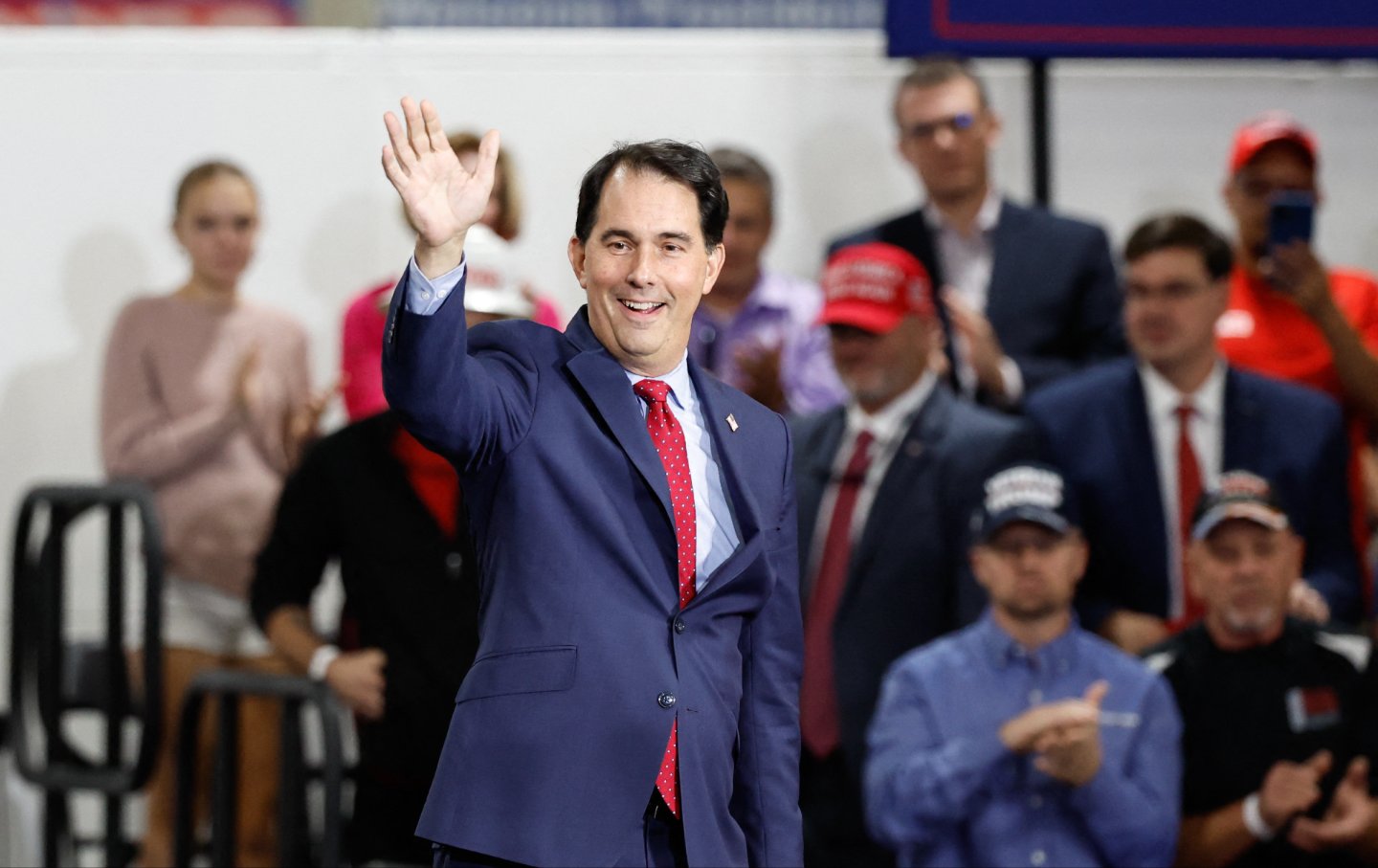
Former Wisconsin Governor Scott Walker arrives to speak during a campaign rally for former US President and Republican presidential candidate Donald Trump at Dane Manufacturing in Waunakee, Wisconsin, October 1, 2024.
(Kamil Krzaczynski / AFP via Getty Images)Former Wisconsin Governor Scott Walker’s assault on labor rights was always wrong, morally and practically.
Walker, a right-wing Republican ideologue who used his position to do the bidding of out-of-state billionaires and corporate-funded “think tanks,” knew that strong unions would make it harder to implement his agenda after his election as Wisconsin’s governor in 2010. So he moved immediately to erect barriers to public-sector organizing and collective bargaining.
As part of a sweeping assault on the underpinnings of civil society, and democracy, Walker unveiled his anti-union Act 10 within days of taking office in 2011. The proposal sparked mass protests by teachers, nurses, librarians, sanitation workers, and other public employees. But Walker pressed ahead with Act 10, which gave special preferences to a handful of public-safety employees while denying them to the vast majority of state, county, and municipal employees. After it was approved by the legislature, the measure was rubberstamped by a state Supreme Court where the conservative majority served as Walker’s amen corner.
Even when Walker’s political career crashed and burned—with the jarring failure of his 2016 bid for the Republican presidential nomination, and the defeat of his 2018 campaign for a third term—Act 10 remained on the books. But a hearty band of union activists and public-interest lawyers keep crying foul. Finally, on Monday, they won their clearest victory yet in the drive to overturn the former governor’s anti-union legacy—which became the template for right-wing assaults on worker rights in other states and nationally.
In a ruling that sent joyous shock waves through labor circles in Wisconsin and across the country, Dane County Judge Jacob Frost restored collective bargaining rights for public employees. Frost’s sweeping decision struck down key sections of Act 10, with an explanation that they violated the Wisconsin Constitution’s equal protection clause. Specifically, Judge Frost determined that Walker had unreasonably and unconstitutionally created a preference for unions representing police and firefighters, which in some cases had supported his campaigns, while effectively eliminating those rights for unions representing teachers and other public employees.
The judge determined that Act 10 was ”irrational and violates the right to equal protection of the laws.” In so doing, Judge Frost —who, in an initial ruling in July, had raised constitutional concerns about Walker’s law—rejected a demand from Walker’s Republican legislative allies for a narrow ruling that would respond to only some aspects of the measure’s obvious lawlessness.
“I cannot solve Act 10’s constitutional problems by striking the definition of ‘public safety employee,’ leaving the term undefined and leaving the remainder of the law in place,” wrote Judge Frost in Monday’s ruling. “Act 10, as written by the Legislature, specifically and narrowly defines ‘public safety employee.’ It is that definition which is unconstitutional. The Legislature cites no precedent for this bold argument that I should simply strike the unlawful definition but leave it to an agency and the courts to later define as they see fit. I am unaware of any such precedent.”
While Republican legislators and their allies will, undoubtedly, challenge the ruling, Walker and his fellow anti-labor Republicans no longer have a Supreme Court that will do their bidding. In recent elections for seats on the court, voters have established a progressive majority that respects the Wisconsin Constitution and the rule of law. The court’s 4–3 new majority will be tested in an election for an open seat in April of 2025, but progressives have become quite skilled at winning judicial contests—with an assist from a state Democratic Party that is led by Ben Wikler, a highly regarded electoral strategist who recently launched a bid for chair of the Democratic National Committee.
What that means is that, while the immediate and longer-term wrangling over labor rights in Wisconsin will continue, there is a very good chance that Judge Frost’s ruling will be upheld (perhaps in short order, if the court moves quickly to take up the case)—thus unraveling Walker’s anti-union legacy and renewing Wisconsin’s historic commitment to the right of workers to organize and collectively bargain. “We’re confident that, in the end, the rights of all Wisconsin public sector employees will be restored,” declared Betsy Ramsdale, a school teacher and union activist from the central Wisconsin city of Beaver Dam, who has been involved in the legal fight to overturn Act 10.
Wisconsin AFL-CIO President Stephanie Bloomingdale announced, ”Nearly 14 years after Scott Walker, in his own words, ‘dropped the bomb’ on Wisconsin public employees, Wisconsin workers can celebrate as the judicial branch restores collective bargaining rights to public employees in Wisconsin. Declaring Wisconsin’s union-busting Act 10 unconstitutional and void, over 60 sections of the 2011 anti-union law have now been struck down.”
“Act 10 has done great harm to working people in our state and has done great damage to the public services our families depend on every day. It has lowered wages and led to staff shortages and long-term vacancies in key public service positions. Working families in Wisconsin will greatly benefit from the restoration of collective bargaining rights. Restoring union freedoms to Wisconsin workers will strengthen Wisconsin’s middle class, lift up the voices of workers, and lead to better public services for our communities,” added Bloomingdale. “Working people in Wisconsin will head into 2025 with a renewed sense of solidarity and a reinvigorated commitment to union organizing so that every worker who wants to be in a union can freely do so. It’s time to turn the page on the dark days of Scott Walker’s union-busting and move forward together with full worker freedoms and union rights for all in Wisconsin.”
Walker did not accept the decision gracefully.
Popular
“swipe left below to view more authors”Swipe →“This is an early Christmas present for the big government special interests,” grumbled the former governor. “This is brazen political activism by this judge on the Dane County bench.”
But Walker is not a lawyer, and he’s never shown much regard for the Constitution.
On the other side of the equation. there are lawyers who do respect basic premises of the law, such as equal protection for all. And they were celebrating Monday—on behalf of the plaintiffs in the suit: the Abbotsford Education Association; the American Federation of Teachers; American Federation of State, County and Municipal Employees, Local 47; American Federation of State, County and Municipal Employees, Local 1215; and members of the Beaver Dam Education Association, SEIU Wisconsin, Teaching Assistants’ Association, Local 3220 and International Brotherhood of Teamsters Local No. 695.
“This historic decision means that teachers, nurses, librarians and other public-sector workers across the state will once again have a voice in the workplace,” explained Jeff Mandell, the president and general counsel for Law Forward, the Wisconsin-based public-interest and pro-democracy law firm that brought the lawsuit. “Every Wisconsin family deserves the chance to build a better future through democratic participation in a union.”
No matter what Scott Walker says.
Support independent journalism that does not fall in line
Even before February 28, the reasons for Donald Trump’s imploding approval rating were abundantly clear: untrammeled corruption and personal enrichment to the tune of billions of dollars during an affordability crisis, a foreign policy guided only by his own derelict sense of morality, and the deployment of a murderous campaign of occupation, detention, and deportation on American streets.
Now an undeclared, unauthorized, unpopular, and unconstitutional war of aggression against Iran has spread like wildfire through the region and into Europe. A new “forever war”—with an ever-increasing likelihood of American troops on the ground—may very well be upon us.
As we’ve seen over and over, this administration uses lies, misdirection, and attempts to flood the zone to justify its abuses of power at home and abroad. Just as Trump, Marco Rubio, and Pete Hegseth offer erratic and contradictory rationales for the attacks on Iran, the administration is also spreading the lie that the upcoming midterm elections are under threat from noncitizens on voter rolls. When these lies go unchecked, they become the basis for further authoritarian encroachment and war.
In these dark times, independent journalism is uniquely able to uncover the falsehoods that threaten our republic—and civilians around the world—and shine a bright light on the truth.
The Nation’s experienced team of writers, editors, and fact-checkers understands the scale of what we’re up against and the urgency with which we have to act. That’s why we’re publishing critical reporting and analysis of the war on Iran, ICE violence at home, new forms of voter suppression emerging in the courts, and much more.
But this journalism is possible only with your support.
This March, The Nation needs to raise $50,000 to ensure that we have the resources for reporting and analysis that sets the record straight and empowers people of conscience to organize. Will you donate today?
Today, Dane County Circuit Court Judge Frost ruled that Act 10, which took away collective bargaining rights from Wisconsin’s public employees, is unconstitutional under the state’s equal protection clause. The decision, stemming from Abbotsford Education Association et al. vs. Wisconsin Employment Relations Commission et al., reaffirms the right of public sector workers, including teachers, state and municipal employees, to collectively bargain for better wages, benefits, and safer working conditions. Public-sector union rights were invented in Wisconsin in 1959. This ruling is a significant victory for Wisconsin’s working families and public employees.
“This historic decision means that teachers, nurses, librarians and other public-sector workers across the state will once again have a voice in the workplace,” said Jeff Mandell, President and General Counsel of Law Forward. “Every Wisconsin family deserves the chance to build a better future through democratic participation in a union. As an organization dedicated to protecting and strengthening democracy, Law Forward is proud to have been a part of this important case.”
More from The Nation
Trump’s War in Iran Opens a Foreign Policy Debate Democrats Can No Longer Avoid Trump’s War in Iran Opens a Foreign Policy Debate Democrats Can No Longer Avoid
The war is forcing Democrats to confront a question they have long deferred: whether the party can offer a coherent anti-war alternative to Washington’s foreign policy consensus.

Disastrous Tides of Fortune Disastrous Tides of Fortune
The consequences of US actions on other nations.

Should Alexandria Ocasio-Cortez Run for President in 2028? Should Alexandria Ocasio-Cortez Run for President in 2028?
David Faris argues that the New York representative is the new national leader the Democrats need, but Daraka Larimore-Hall claims she can get more done in Congress.

Is AIPAC Doomed? Is AIPAC Doomed?
The hard-line pro-Israel lobby is facing more opposition than ever before. But fully defanging it won’t be easy.
A Trial by Fire for Tisch and Mamdani, New York’s Premier Odd Couple A Trial by Fire for Tisch and Mamdani, New York’s Premier Odd Couple
How this weekend’s failed attack outside Gracie Mansion could reinforce the strange-bedfellows alliance between the mayor and the police commissioner.

Anthropic’s Lawsuit Should Absolutely Destroy the Pentagon in Court Anthropic’s Lawsuit Should Absolutely Destroy the Pentagon in Court
But make no mistake: The company is not one of the good guys.

